
There were 15 older adults with OSA who did not purchase CPAP and participated in the study. The average (SD) age of all patients was 67.73 (5.84) years with a proportion of male patients of 46.67% (7 patients). These participants lived in various villages across different provinces in the Northeastern region including Khon Kaen, Roi Et, Maha Sarakham, Buriram, and Nong Khai. Most participants lived with spouses or grandchildren. The majority had occupations or past experience as hired labors and farmers such as growing vegetables, or farming sugar cane, corn, cassava, or rice. Most participants had an AHI between 5 and 30 events/hour with low-income. All participants received an elderly allowance from their local administrative organization. This monthly stipend of 240 USD represents a key initiative by local authorities to enhance the quality of life for low-income seniors. Additionally, they were registered with social welfare agencies under the Department of Social Development and Welfare (Ministry of Social Development and Human Security), which oversees the disbursement of these benefits. Beyond the elderly allowance, some participants received occasional financial assistance from their sons or daughters. Yet such support was irregular, as many of their children faced their own financial constraints—including debts and installment-based purchases of household goods. In contrast, a portion of elderly respondents depended on personal savings accumulated during their working years.
Themes of barriers of continuous positive airway pressure machine purchasing
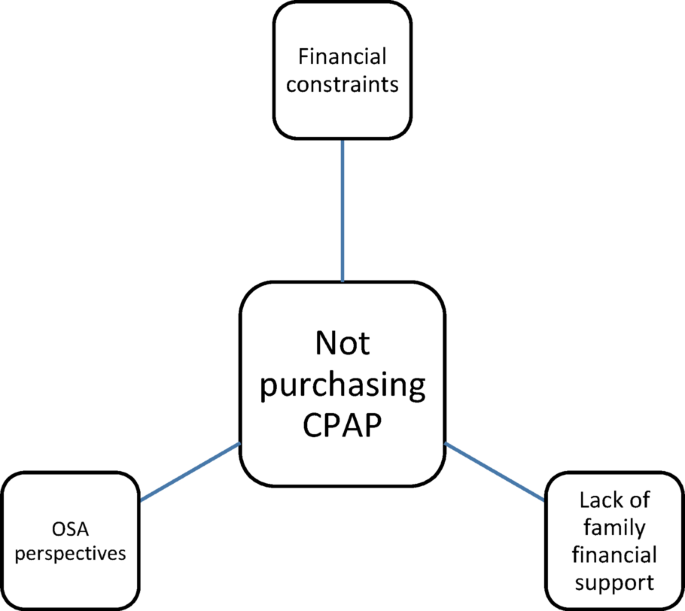
There were three themes on why the older adults with OSA did not purchase CPAP including financial constraints, lack of family financial support, and OSA perspectives (Fig. 1).

Showed barriers of a continuous positive airway pressure machine (CPAP) purchasing in elderly patients with obstructive sleep apnea.
-
1.
Financial Constraints.
Several participants reported financial hardship as a primary reason for not purchasing a CPAP machine.
“I do not have enough money even for daily use. I receive welfare money from the government for older individuals, but it is not enough. I have to ask for money from my adult child as I have to take care of my grandchildren. This is a difficult situation for me, so I am unable to purchase the machine.” (Mr. J, 75 years, divorced).
“The machine is too expensive for me working as a farmer. It would be better if I can buy the machine as a co-pay.” (Mr. SU, 69 years, one son, four grandchildren).
“I did not buy the machine because I do not have enough money. I receive pension from the government, but I also have a lot of debt. As a result, I have just enough money for daily living but no saving money.” (Ms. PT, 72 years, widowed, hypertension, frequent fallings, and vascular disease).
-
2.
Lack of family financial support.
Older adults with OSA are reluctant to ask for support from their family members. Additionally, some patients may not get enough financial support from their family members, making them decide not to purchase CPAP machines.
“I am so worried that I may die from sleep apnea, and I will leave my grandchildren behind. I do not have enough budget for the machine. For now, my budget is good for only daily living but not for anything else. I have to deal with it, living without the machine. I do not want to bother my family members, my sons or my daughters. They also have limited budgets for their families. I do not want them to get in troubles as they have a lot of debts.” (Mr. J, 75 years, divorced).
“I want to have the machine, but I do not have enough budget. My sons and daughters also do not have extra money for me to get the machine. I do not want to bother them.” (Ms. M, 66 years, 6 children).
“I am able to live with sleep apnea as I do not have any income. I do not want to bother my sons. My wife said that we do not have money to buy it; so do my sons. The price is too expensive for us.” (Mr. JP, 68 years, married).
“Our sons gave us some money occasionally. But we do not bother them. We earn some money and use it for our daily lives. We give some extra money to our sons, but we do not want to get some money from them.” (Mr. U, 64 years, second marriage, stroke, cardiac arrhythmia, employee).
-
3.
OSA perspectives.
Older adults with OSA who did not purchase CPAP pointed out that they did not want to treat OSA, though they already had several consequences of OSA. They believed that they had OSA for a long time and wanted to live with OSA resulting in denying CPAP therapy. Conservative treatment with other options was justified for them. Additionally, they were not afraid of death and expected to die peacefully.
“I told myself that I am so old so it may be the time to leave the world. According to the Buddhism philosophy, everyone has to pass away at the appropriate time. So, I do not want to bother anyone. It may be good to pass away while sleeping from sleep apnea as it may not hurt and be better than being stroke and bedridden. I will treat it with other strategies such as keep exercising, breathe fresh air, or do meditation. I believe in karma and hope that my good karma will support me to face with good things in the future.” (Ms. Y, 62 years, diabetes, hypertension, and dyslipidemia).
“My doctor told me that I have sleep apnea. But I do not feel frightened or scared as it is common to have diseases. I believe in karma and would like to die during the night as it may not be tortured.” (Mr. B, 63 years, married, two sons, daily employee, hypertension).
“I will leave it alone and see what will happen. I do not have enough money to buy the machine. I had it for years before I had a stroke. I do not mind, and I do not care what will happen to me. I cannot do anything much about my health.” (Mr. U, 64 years, second marriage, three sons, stroke, cardiac arrhythmia, daily employee).
link