


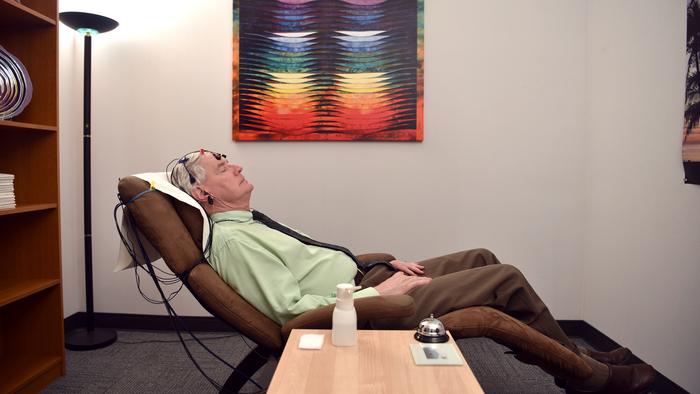
Picture a stressed emergency room nurse settling into a zero-gravity chair, eyes closed, as gentle tones play through headphones. But these aren’t just any sounds: they’re her own brainwaves, transformed into music and played back to her in real time. According to new research from Wake Forest University, this unusual approach might be exactly what healthcare workers need to combat their mounting stress levels.
The study, published in Global Advances in Integrative Medicine and Health, tested whether a technology called acoustic neuromodulation could help reduce stress, anxiety, and insomnia among healthcare professionals. The results were striking: participants who received just four sessions over two weeks reported significant improvements across multiple measures of well-being.
“Health care workers are experiencing unprecedented levels of stress and anxiety, and scalable, evidence-based interventions are urgently needed,” explained Dr. Charles H. Tegeler, professor of neurology at Wake Forest University School of Medicine and the study’s principal investigator.
How Sound Rewires Stress Patterns
The technology works by reading electrical activity from the brain through sensors, then translating those brainwave patterns into customized sound sequences. These personalized tones are played back to participants in near real-time, creating what researchers call a “closed-loop” system.
Think of it as holding up an acoustic mirror to the brain. When the brain hears its own activity reflected back as sound, something remarkable happens: it begins to harmonize and balance itself, breaking free from what researchers describe as “stuck stress patterns.”
The science behind this rests on brain plasticity: the brain’s ability to reorganize itself. When people experience repeated stress or trauma, their brains can get locked into survival mode, with the autonomic nervous system constantly on high alert. This technology appears to help the brain find its way back to a more balanced state.
“These results suggest that closed-loop acoustic neuromodulation is a safe, scalable, and effective option to complement organizational strategies for supporting health care worker brain health and well-being.”
The study included 144 healthcare workers who reported moderate to high stress levels. Half received the sound therapy while the other half were placed on a waitlist. Each session lasted about 36 minutes, during which participants simply relaxed in a comfortable chair with their eyes closed.
Beyond Stress Relief
While the primary goal was reducing perceived stress, the benefits extended well beyond that single metric. Participants also showed improvements in anxiety, sleep quality, fatigue, depression symptoms, and even cognitive function. Perhaps most importantly, the intervention proved both safe and practical, with no serious adverse events reported.
What makes this approach particularly promising is its accessibility. Unlike some previous studies that excluded participants on medications or required lengthy treatment protocols, this research streamlined the process. The sessions were brief, the technology noninvasive, and the results meaningful.
Since 2011, Wake Forest researchers have been evaluating this technology, known as Cereset Research, building a substantial body of evidence for its effectiveness. The current study represents an important step forward in making the intervention more practical for real-world healthcare settings.
For healthcare workers who have shouldered extraordinary burdens, especially in recent years, the prospect of a brief, effective stress reduction tool could be game-changing. As hospitals and clinics grapple with burnout and staffing challenges, innovations like acoustic neuromodulation might offer part of the solution.
The research team is already looking ahead, with future studies planned to examine how long the benefits last and whether periodic maintenance sessions might help sustain improvements. They’re also investigating the technology’s specific effects on the autonomic nervous system, which could reveal more about how and why this unusual approach works.
In an era when healthcare workers desperately need support, the idea of healing by listening to one’s own brain offers both practical hope and a certain poetic justice: those who dedicate themselves to healing others might find restoration in the symphony of their own minds.
The study was supported by The Susanne Marcus Collins Foundation, Inc., with infrastructure support from the National Institutes of Health.
If our reporting has informed or inspired you, please consider making a donation. Every contribution, no matter the size, empowers us to continue delivering accurate, engaging, and trustworthy science and medical news. Independent journalism requires time, effort, and resources—your support ensures we can keep uncovering the stories that matter most to you.
Join us in making knowledge accessible and impactful. Thank you for standing with us!
link